You’ve planned the ultimate winter journey: flying to the Arctic Circle, armed with layers of thermal gear and a camera ready to capture the elusive Aurora Borealis. You check the solar forecast, the skies are clear—everything is perfect.
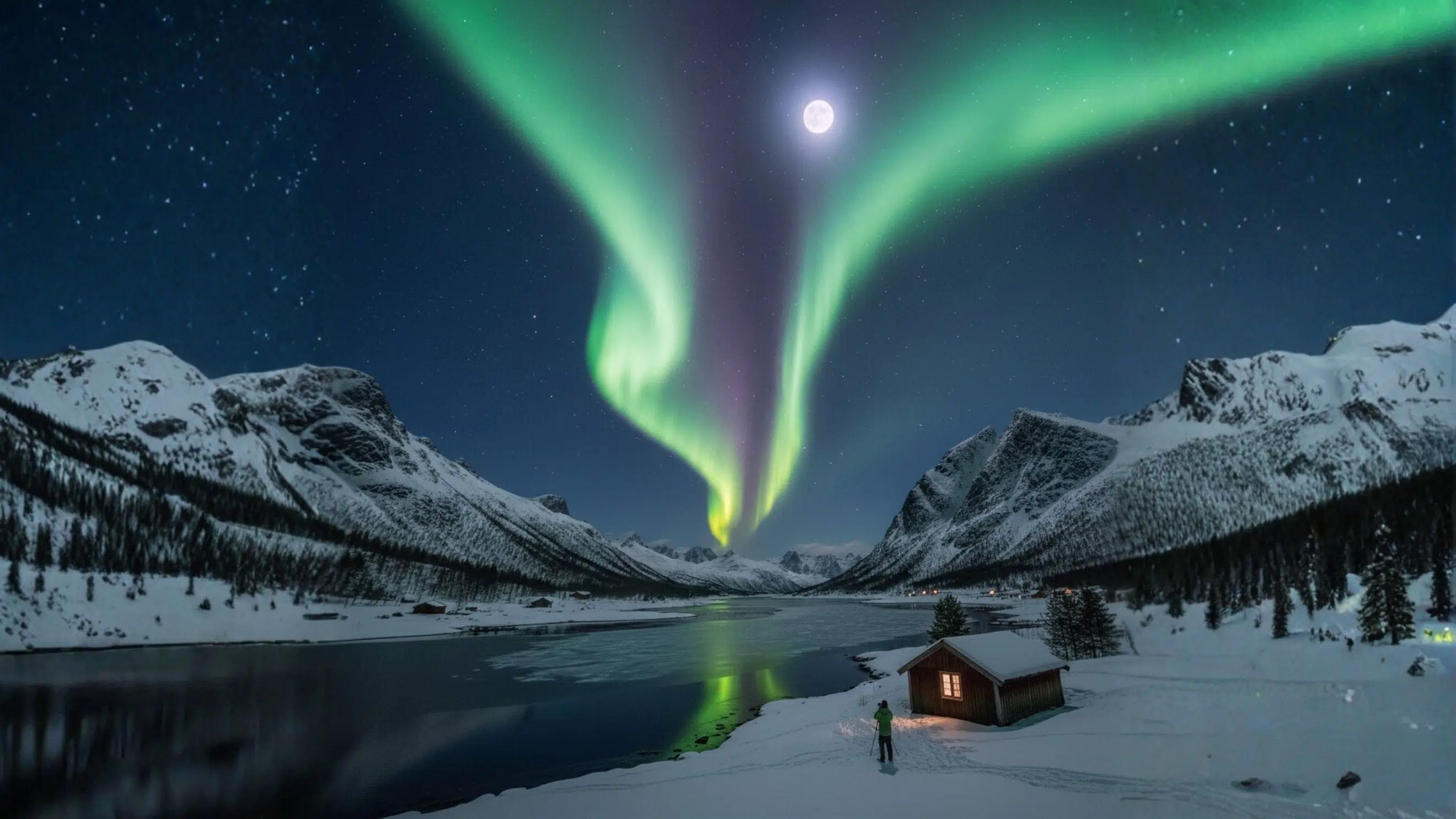
Then, you look up and realize the moon is a giant, blinding orb: A brilliant Full Moon.
The burning question hangs heavy in the crisp night air: Does the intense light of a full moon completely ruin your chances of seeing the Northern Lights?
The short answer, delivered with the confidence of planetary science, is No, the Full Moon will not stop the Aurora. But it will change the experience. Let’s dive deep into the science of light pollution, lunar brightness, and maximizing your viewing success.

🌕 The Science Showdown: Lunar Light vs. Solar Wind
To understand this dynamic, we need to compare the two light sources competing for your attention:
- The Lunar Light (The Competitor): The moon reflects the sun’s light back to Earth. A Full Moon can illuminate the landscape almost as brightly as dusk, dramatically increasing the background light level.
- The Aurora (The Main Event): The Northern Lights are caused by energized particles from the sun (the solar wind) colliding with gases in Earth’s atmosphere. This process generates its own light, independent of the moon.
The Verdict: The phenomenon of the aurora itself is unaffected by the moon. A strong G2 or G3 class geomagnetic storm will still produce brilliant dancing lights, regardless of the lunar cycle.
💡 Maximizing Your Viewing: The Contrast is Key
The challenge isn’t the existence of the aurora, but the contrast needed for your eyes (and camera sensor) to perceive it.
| Aurora Strength | Impact of Full Moon | What You Will See |
| Weak (KP 1-2) | Significant visual interference. | The faint, diffuse green glows may be completely washed out by the lunar glare, making them nearly invisible to the naked eye. |
| Moderate (KP 3-4) | Noticeable reduction in vibrancy. | You will clearly see the curtains, but the subtler pinks, reds, and yellows will be muted. The main green band will dominate the sky. |
| Strong (KP 5+) | Minimal visual impact. | The intense, fast-moving, and tall pillars of light will easily overpower the moon. This is when the aurora truly shines, even on a bright night. |
Experience Tip: “Don’t fear the moon—embrace it! The moonlight actually illuminates the snowy landscape, providing breathtaking contrast and definition to your photos, a feature that dark nights often lack.”

📸 The Photographer’s Edge: Utilizing Moonlight
While darkness is preferred, a Full Moon offers an incredible opportunity for photographers seeking a unique shot.
- Reduce Exposure Time: On a moonless night, you might need 15–30 second exposures. With a Full Moon, you can often cut this down to 3–8 seconds. This shorter time reduces motion blur and keeps the stars looking sharp.
- Foreground Definition: The moon acts as a gigantic natural softbox, perfectly lighting the snow, mountains, and cabins in your foreground. This adds depth and context, turning a sky shot into a stunning landscape.
- Adjust ISO: Keep your ISO lower (between 400 and 1600) to compensate for the extra light and reduce digital noise.
🗺️ The Great Planet Guide: Planning Your Lunar Aurora Hunt
To successfully chase the aurora during the bright phase of the moon, focus on these three factors:
- 1. Choose the Right Location: Select destinations known for high geomagnetic activity (like Tromsø, Norway; Yellowknife, Canada; or Abisko, Sweden). A consistently strong aurora increases your odds regardless of the moon.
- 2. Check the KP Index: Only head out when the Kp-Index (the measure of geomagnetic storm strength) is predicted to be 3 or higher. You need power to fight the light.
- 3. Timing is Everything: The aurora is typically most active between 10 PM and 2 AM. During a Full Moon, try to look for the moon’s position. If it’s low on the horizon, look for the aurora in the opposite direction where the sky is relatively darker.
The biggest threat to seeing the Northern Lights is always cloud cover, not the moon. If the skies are clear and the solar activity is robust, that pale green dance will still light up the sky, painting the moonlit snow in a beautiful, ethereal glow.

Leave a Reply